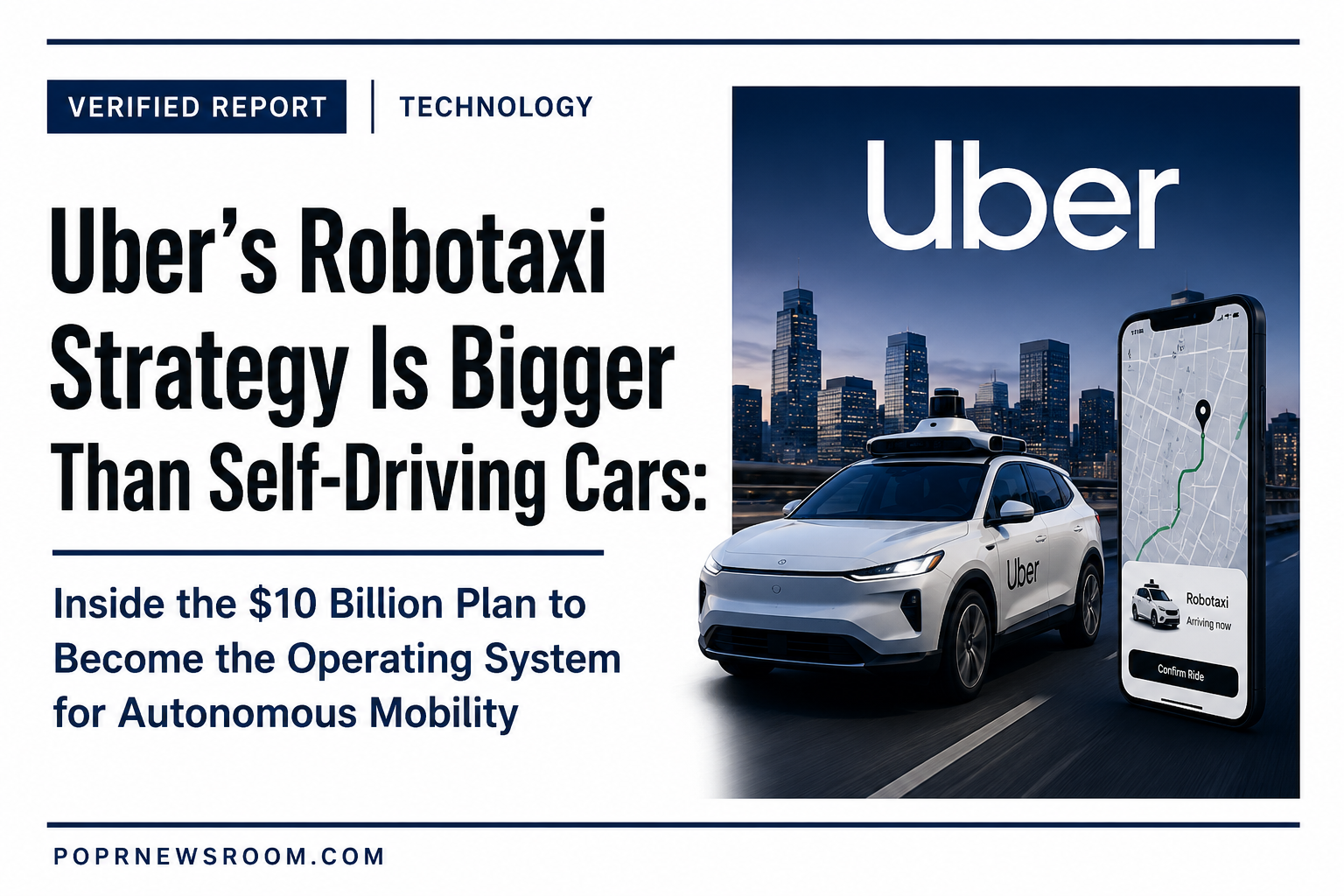
Uber is not building one universal self-driving system. The company is making a structurally different bet: that autonomous transportation will remain fragmented across many vehicle makers, autonomy developers, chip suppliers and fleet owners long enough for whoever controls demand, dispatch, financing, fleet operations and rider infrastructure to capture durable commercial value regardless of which underlying technology ultimately wins. That strategy is no longer inferred from a handful of partnership announcements. In February 2026, Uber formally launched Uber Autonomous Solutions, converting the inference into a named product. The company has since committed more than $10 billion to autonomous-vehicle expansion while working with more than 20 AV partners across North America, Europe, the Middle East and Asia.
The threat that robotaxis would eventually disrupt Uber has not disappeared. Waymo already operates direct consumer service in several U.S. markets entirely outside Uber. Zoox retains its own app. Verne launched its Zagreb robotaxi service through its own application before Uber integration followed. Different autonomous-vehicle companies are pursuing different relationships with the rider. Uber's response has become progressively clearer: instead of trying to own one universal autonomous-driving stack, Uber is building infrastructure capable of commercializing many of them simultaneously.
What Is Uber Autonomous Solutions?
The clearest evidence for Uber's strategy arrived on February 23, 2026, when Uber launched Uber Autonomous Solutions, a formal product line designed to commercialize autonomous vehicles developed by other companies.
The offering packages capabilities that Uber built over more than a decade of ride-hailing operations: AV training data, mapping, regulatory support, fleet financing, in-car user experience, customer support, remote assistance, field operations, insurance and a system called AV Mission Control. CEO Dara Khosrowshahi described the initiative as Uber "externalizing" those operating capabilities. That statement changes how Uber's robotaxi partnerships should be understood. Before Autonomous Solutions, it was possible to view Uber's expanding AV relationships as a collection of individual deals. After Autonomous Solutions, the role itself became a product. Uber is effectively offering autonomous-vehicle developers a commercial pathway: you build the driving technology, Uber can help turn it into a transportation service.
What Does Uber Actually Provide to a Robotaxi Company?
Autonomy is only one part of operating a transportation network. A vehicle that can drive itself still has to be placed somewhere useful, find passengers, know where demand is forming, get charged, cleaned and maintained. Someone has to handle customer service, manage incidents, work with regulators, design the passenger experience, monitor vehicles remotely, coordinate fleets and finance infrastructure.
Uber Autonomous Solutions packages many of those functions around the autonomous-driving stack. That produces a critical distinction. Uber generally does not own the core self-driving technology supplied by Pony.ai, Nuro, NVIDIA, Zoox, Waymo, Rivian or Wayve. But Uber is not technologically passive around that exclusion. It increasingly owns software and operational infrastructure around dispatch, commercialization, fleet intelligence, rider experience, mission control and marketplace orchestration. The robot may drive the car. Uber is attempting to operate the market around the robot.
How Large Is Uber's Autonomous-Vehicle Network?
Much larger than four partnerships. Reuters reported in March 2026 that Uber was working with approximately 25 autonomous-vehicle technology developers. Uber separately stated in February, alongside its Baidu partnership announcement, that more than 20 AV partners were already completing millions of autonomous trips annually. TechCrunch has described the portfolio as exceeding 30 partnerships, but that higher figure represents secondary reporting rather than a primary-confirmed count; primary and Reuters-supported evidence places the network above 20 and around 25.
The important conclusion does not depend on whether the precise count is 21, 25 or above 30. Uber has moved well beyond an isolated handful of robotaxi experiments. Its portfolio spans North America, Europe, the Middle East and Asia and includes fundamentally different types of companies operating under fundamentally different capital structures. That diversity is the strategy.
Why the Pony.ai Partnership Matters in Europe
Pony.ai provides one of the clearest examples of how Uber is expanding internationally. Uber, Pony.ai and Verne announced their Croatian partnership on March 26, 2026. The date matters because the service did not commercially launch that day. Pony.ai's own investor materials establish that paying public service began in Zagreb on April 8, 2026, initially through Verne's own application, with Uber platform integration following afterward.
In August, Pony.ai and Uber announced plans for more than 2,000 robotaxis across five European cities, including Zagreb, with additional expansion planned into the Middle East. Reuters independently confirmed the announced figure. But the 2,000-vehicle number is a deployment plan without a stated rollout-completion timetable. It is not a current fleet count. Zagreb remains the only commercially operating city among the five announced European locations as of this verification date. That distinction is essential. Uber has a large announced expansion plan. It does not yet have 2,000 Pony.ai robotaxis commercially operating across Europe.
Pony.ai has also cited unit-economics breakeven in Guangzhou and Shenzhen as evidence supporting international expansion. Those claims are company-reported operating metrics, not independently verified profitability; "unit economics" is a narrower claim than company-level profitability and depends on Pony.ai's own metric definitions.
Who Owns the Zagreb Customer Relationship?
Not Uber exclusively. That is an important correction to the simplest marketplace thesis. The Zagreb service began through Verne's own app. Uber became another distribution channel afterward. This tells us something meaningful about how Uber has structured the partnership: Uber does not require every autonomous partner to surrender its direct consumer relationship. In some partnerships, Uber is exclusive. In others, it is additive. That flexibility may be one reason the portfolio can accommodate so many different suppliers, since an autonomy company does not always have to choose between building its own brand and joining Uber.
The Lucid-Nuro Deal Shows a Completely Different Model
The Lucid and Nuro program looks almost nothing like Pony.ai and Verne. Lucid supplies the vehicle. Nuro supplies the autonomous-driving system. Uber and fleet partners are intended to own or operate the vehicles. Distribution is designed around Uber exclusively.
Uber originally committed in July 2025 to 20,000 Lucid Gravity vehicles. In April 2026, the company entered a second vehicle-production agreement covering at least 25,000 Lucid Midsize vehicles. The combined minimum commitment is not 45,000. Lucid's SEC filings contain offset provisions between the two agreements, resulting in a combined minimum of at least 35,000 vehicles. That distinction matters because simple arithmetic would misstate the legal structure of the commitments. Uber's total investment in Lucid has reached $500 million, while Lucid's own proxy filing states Uber holds approximately 11% beneficial ownership following the April transaction.
This is no longer a purely marketplace-style relationship. Uber has capital inside the vehicle company, vehicle commitments and a role in building operating infrastructure.
What Is Uber Building in Houston?
Uber has announced a 50,000-square-foot Houston depot supporting the Lucid and Nuro robotaxi program. Independent coverage adds more granular specifications, including approximately 40 fast chargers and 15 maintenance bays, although those details come from secondary reporting rather than Uber's own primary release. The depot matters because it exposes the physical side of Uber's autonomous strategy. Robotaxis require charging, storage, servicing, cleaning and fleet operations infrastructure. The existence of dedicated depot infrastructure weakens any easy description of Uber's autonomy strategy as purely asset-light.
Uber Is Committing More Than $10 Billion to Autonomous Vehicles
During Uber's August 2026 Q2 reporting cycle, the company said it expects to commit more than $10 billion over the coming years to autonomous-vehicle expansion. That capital is expected to flow through a mixture of equity investments, fleet support and vehicle commitments. The number materially changes how Uber's robotaxi economics should be understood. Uber is investing in Lucid. It may invest up to $1.25 billion in Rivian. It is making vehicle commitments, supporting depots, participating in charging and fleet infrastructure, and offering fleet financing and insurance through Autonomous Solutions. The most accurate description of what Uber is building: technology-light relative to full vertical autonomy development, but increasingly capital-active in the commercialization infrastructure surrounding autonomous fleets. That is a meaningfully different business than simply putting someone else's robotaxi inside the Uber app.
Why the Rivian Deal Is So Important
Rivian adds another structurally distinct ownership model. Uber announced on March 19 that it may invest up to $1.25 billion in Rivian through 2031, tied to autonomous-performance milestones. The initial program calls for 10,000 autonomous Rivian R2 robotaxis, with an option pathway toward as many as 40,000 additional vehicles beginning in 2030. Initial deployments are planned for San Francisco and Miami in 2028, with expansion toward 25 cities.
Rivian differs sharply from Lucid and Nuro. Lucid provides the vehicle while Nuro provides autonomy as separate companies. Rivian intends to develop the vehicle, compute and autonomy stack itself. Uber's role becomes capital plus exclusive ride-hailing demand. That is precisely why treating Uber's AV strategy as one repeatable partnership template fails. The company is accepting fundamentally different upstream architectures, not applying one model to every supplier.
What Is NVIDIA's Role in Uber Robotaxis?
NVIDIA represents another structural model entirely. NVIDIA does not supply a finished robotaxi. But describing its role as software-only would also be wrong. The announced architecture centers on NVIDIA DRIVE Hyperion, an integrated autonomous-vehicle hardware and compute platform, combined with DRIVE AV software, the Alpamayo reasoning model and NVIDIA's Halos safety architecture. Vehicle manufacturers integrate that platform into their cars. Uber then participates in commercialization. NVIDIA itself describes DRIVE Hyperion as an end-to-end AV platform, and Uber's own announcement placed it at the center of the deployment description. NVIDIA does not supply the vehicle; it supplies an integrated compute, hardware-platform and autonomy-software stack that OEM partners build into vehicles deployed through Uber.
The current deployment plan starts in Los Angeles and San Francisco in the first half of 2027, followed by expansion toward 28 cities across North America, Europe, Australia and Asia by 2028 through a phased rollout beginning with data collection, moving through operator-led service and eventually full driverless operation.
Is Uber Planning 100,000 Robotaxis Across 28 Cities by 2028?
That combined formulation is not supported by the primary evidence. Two real targets have been merged repeatedly in secondary headlines. NVIDIA's October 2025 announcement established a separate, earlier target of scaling Uber's autonomous fleet toward 100,000 vehicles over time beginning in 2027. Separately, the March 2026 Uber and NVIDIA announcement established the 28-city deployment target by 2028. The primary March 2026 release does not connect those two figures into one statement promising 100,000 robotaxis across 28 cities by 2028. The accurate reporting keeps them separate: Uber and NVIDIA have targeted autonomous fleet scale approaching 100,000 vehicles over time beginning in 2027, and have separately announced a 28-city deployment framework by 2028. Merging them into one number turns two real targets into an unsupported claim.
Where Does Zoox Fit?
Zoox provides another test of Uber's marketplace logic. Uber and Zoox announced their partnership on March 11, 2026, targeting Las Vegas by summer 2026 and Los Angeles by mid-2027. Zoox retains its own consumer application in both markets. Uber becomes an additional booking channel, not a replacement for Zoox's direct service. Zoox still controls its purpose-built vehicle and direct service while Uber adds demand. This is one of the clearest examples of Uber accepting a partner that wants to retain its own marketplace identity.
What About Waymo?
Waymo exposes both the strength and the potential vulnerability of Uber's strategy. Uber and Waymo remain partners in Austin and Atlanta. They are no longer partners in Phoenix. That relationship ended in May 2026, and Waymo vehicles are no longer bookable through Uber there. Waymo operates independent service outside Uber in Phoenix, San Francisco, Los Angeles, Dallas and Houston. Waymo is simultaneously a partner and a direct competitor.
Reuters reported in July 2026, citing the Financial Times, that Waymo had considered eventually ending its remaining Uber partnerships and entering those shared markets independently when contract terms permit. Reuters could not independently verify that as a confirmed Waymo plan. Khosrowshahi subsequently stated in August that he expected Uber and Waymo to continue working together in Austin and Atlanta while Uber expands its broader AV portfolio. The current, complete picture: Uber and Waymo are partners in some markets, direct competitors in others, and potentially moving toward greater independence over time. The Verge has also reported signs of disagreement including opposition over pending robotaxi legislation in Washington, D.C., alongside operational tensions; that is supported secondary reporting, not primary-confirmed regulatory conflict.
Waymo represents the most important stress test of Uber's platform thesis. A strong autonomy provider can decide it wants the direct rider relationship. Uber cannot assume every robotaxi company will permanently need its marketplace. Its defense is scale, demand and commercialization infrastructure.
WeRide, Wayve, Baidu and Volkswagen Make the Portfolio Global
Uber's strategy extends far beyond the better-known U.S. programs. WeRide is targeting at least 1,200 robotaxis across Abu Dhabi, Dubai and Riyadh, with separate European plans involving Madrid and Zurich. Wayve and Nissan are preparing a Tokyo program as part of a broader Wayve and Uber plan spanning more than ten cities, including London. Baidu has a multi-year agreement with Uber involving thousands of Apollo Go vehicles across markets outside the United States and mainland China, including active expansion into Dubai. Volkswagen and MOIA add another partnership relationship. Additional Uber relationships include Motional, Avride and Momenta.
The result is not one robotaxi architecture spreading globally. It is a deliberate portfolio spanning meaningfully different capital structures, vehicle ownership models and geographic footprints.
Uber Is Building a Marketplace for Different Kinds of Autonomous Supply
The capital-model taxonomy across Uber's portfolio is the strongest forward-looking conclusion in the evidence base. At least four distinct capital and ownership models have emerged across Uber's AV partnerships, not one repeatable template.
The Pony.ai model: Pony.ai autonomy, Verne fleet and operator role, Uber as platform integrator and Verne investor. The Lucid and Nuro model: Lucid vehicle, Nuro autonomy, Uber and fleet partners own and operate vehicles, Uber-exclusive distribution. The Zoox model: Zoox controls the purpose-built vehicle and its own direct service, Uber added as marketplace channel without displacing the existing relationship. The NVIDIA model: NVIDIA supplies the integrated compute, hardware-platform and software ecosystem, OEM partners supply vehicles, Uber supplies commercialization. The Rivian model: Rivian vertically develops the vehicle, compute and autonomy stack, Uber supplies capital and exclusive ride-hailing demand.
Those are not variations around one ownership structure. They are fundamentally different commercial arrangements. Uber's platform is being designed to accept them all. That is a meaningfully stronger and more specific platform thesis than "Uber partners with robotaxi companies."
Why This Looks More Like an Operating System Than a Robotaxi Fleet
An operating system does not manufacture every application that runs on it. It provides common infrastructure through which many different applications can operate. Uber is attempting something analogous economically. Different autonomy providers can supply different driving systems. Different manufacturers can supply vehicles. Different fleet owners can own the assets. Different financing structures can fund them. Different regional partners can operate them. Uber can provide a common layer for demand, dispatch, routing, rider experience, support, fleet intelligence, mission control and commercial operations.
The analogy is not literal software architecture. It is a business-model description. Uber is attempting to become the commercialization operating system for autonomous transportation. That description is considerably more precise now that Uber has formally launched Autonomous Solutions as a named, sold product rather than an implicit capability.
Why Uber Does Not Need to Win the Self-Driving Technology Race
Uber does not build one of the proprietary autonomy stacks supplied by its AV partners. The emerging 2026 strategy makes clear why that exclusion is not a liability. Uber does not need Pony.ai to beat Waymo. It does not need Nuro to beat NVIDIA. It does not need Rivian to beat Zoox. It does not need one vehicle architecture to dominate every geography.
The ideal commercial outcome for Uber may actually be a competitive supplier market. If several capable autonomy companies compete to provide robotaxi supply, Uber can potentially integrate them into one demand network. That is structurally similar to how marketplaces become stronger when suppliers remain fragmented while demand becomes aggregated. Uber's greatest strategic risk may therefore not be that one self-driving company becomes technologically excellent; it may be that one becomes technologically excellent and commercially dominant enough to aggregate demand without Uber.
The Rider Relationship Is the Battleground
Uber does not own the rider relationship universally. Zoox retains its app. Verne retained its app through the Zagreb launch. Waymo owns its direct relationship in markets where it operates independently. But the Nuro and Lucid program and the Rivian program are both specifically designed around Uber-exclusive distribution. Uber therefore has different degrees of marketplace control across its portfolio, ranging from exclusive platform to coexisting channel to investor and commercialization services provider. The variability is not merely a contractual detail. It shows how flexible the platform strategy has become, and it is itself evidence of a deliberately multi-model approach rather than one structure applied uniformly.
What the Strategy Could Look Like by 2028
The verified commitments already suggest the shape of the next stage. NVIDIA-linked deployments are targeting 28 cities by 2028. Rivian's initial autonomous R2 rollout is planned for 2028, beginning in San Francisco and Miami before broader expansion. Wayve and Nissan are preparing Tokyo. Pony.ai and Uber are expanding beyond Zagreb into additional European cities and the Middle East. WeRide is targeting the Middle East and Europe. Baidu is moving outside mainland China through its Uber relationship. Lucid and Nuro are targeting Houston in 2027. Zoox is being added as another Uber channel while preserving its direct service. None of those plans guarantees deployment exactly on schedule. Taken together, they establish how aggressively Uber is assembling autonomous supply.
What Uber Is Really Betting On
The strongest Uber robotaxi thesis is no longer the simple claim that Uber does not need to build self-driving cars. It does need vehicles. It needs fleets. It needs depots. It needs charging. It needs capital and infrastructure. What it is avoiding is a different burden: betting the company on one proprietary autonomous-driving technology. Instead, Uber is diversifying the technological risk across many suppliers while investing heavily in the layer that connects those suppliers to commercial demand.
Uber's autonomy strategy ultimately rests on a market-structure thesis. The company is betting that robotaxis become enormous, and also that the market remains fragmented enough that no single autonomy company controls everything. Different AV developers can win in different cities. Different OEMs can supply different vehicles. Different capital structures can coexist. Uber does not necessarily have to predict which company becomes the best autonomous-driving developer. It needs enough of them to need commercialization. And it is spending more than $10 billion betting that the problem of turning autonomous vehicles into scalable transportation businesses remains valuable long after the problem of making vehicles drive themselves is solved.
Frequently Asked Questions
Is Uber building its own universal self-driving technology?
No. Across the major partnerships covered in this report, the underlying autonomous-driving systems are supplied by companies including Pony.ai, Nuro, NVIDIA ecosystem partners, Zoox, Waymo, Rivian and Wayve. Uber increasingly owns commercialization, dispatch, fleet and rider infrastructure around those systems rather than one universal driving stack.
What is Uber Autonomous Solutions?
Uber Autonomous Solutions is a business line launched February 23, 2026 that packages capabilities including AV training data, mapping, regulatory support, fleet financing, in-car user experience, customer support, mission control, remote assistance, field operations and autonomous-vehicle insurance for AV developers seeking to commercialize their technology through Uber's platform.
How much is Uber committing to autonomous vehicles?
Uber said during its August 2026 Q2 reporting cycle that it expects to commit more than $10 billion over coming years to autonomous-vehicle expansion, flowing through a mixture of equity investments, fleet support and vehicle commitments.
How many autonomous-vehicle partners does Uber have?
Primary and Reuters-supported evidence places the current network above 20 and around 25 technology developers. TechCrunch has reported more than 30 partnerships, but that higher figure is secondary reporting rather than the primary-supported count.
Are 2,000 Pony.ai robotaxis already operating in Europe?
No. More than 2,000 vehicles across five European cities is an announced deployment plan without a stated completion timetable. Zagreb is presently the only commercially operating city among those five announced European locations.
When did the Zagreb commercial service actually launch?
April 8, 2026. The March 26, 2026 date was the partnership announcement, not the start of paid public service. Commercial service, meaning the public could book and pay for rides, began April 8, 2026 through Verne's own application, with Uber platform integration following afterward.
How many Lucid vehicles has Uber committed to?
The combined minimum commitment is at least 35,000 vehicles after contractual offset provisions between Uber's July 2025 agreement for 20,000 Lucid Gravity vehicles and its April 2026 agreement for at least 25,000 Lucid Midsize vehicles. Simple arithmetic would produce 45,000, but Lucid's own SEC filings establish offset provisions that result in a combined minimum of at least 35,000.
How much of Lucid does Uber own?
Lucid's own proxy filing states Uber holds approximately 11% beneficial ownership following the April 2026 transaction.
How much has Uber invested in Lucid?
Uber's total investment in Lucid has reached $500 million.
What does NVIDIA provide to Uber's robotaxi program?
NVIDIA supplies an integrated compute, hardware-platform and autonomy-software ecosystem including NVIDIA DRIVE Hyperion, DRIVE AV software, the Alpamayo reasoning model and Halos safety architecture. NVIDIA does not supply the finished vehicle; it supplies the integrated platform that OEM partners build into vehicles deployed through Uber.
Will Uber have 100,000 robotaxis in 28 cities by 2028?
That combined statement is not supported by the primary evidence. The approximately 100,000-vehicle scaling target originated in a separate NVIDIA announcement from October 2025. The 28-city-by-2028 deployment plan is a separate March 2026 target. The primary March 2026 release does not merge those two figures into one statement, and doing so would misrepresent two distinct commitments.
Does Uber exclusively own the robotaxi customer relationship?
No, and exclusivity varies meaningfully by partner. Zoox retains its own app in Las Vegas and Los Angeles. Verne launched independently in Zagreb before Uber integration followed. Waymo operates direct service outside Uber in Phoenix, San Francisco, Los Angeles, Dallas and Houston. The Nuro and Lucid program and the Rivian program are both designed around Uber-exclusive distribution.
Is Waymo still available through Uber in Phoenix?
No. The Uber-Waymo Phoenix partnership ended in May 2026 and Waymo vehicles are no longer bookable through Uber there. Austin and Atlanta remain active Uber-Waymo partnership markets. Waymo operates its own independent service in Phoenix, San Francisco, Los Angeles, Dallas and Houston outside Uber entirely.
Research basis: This report was developed from KG-UBER-ROBOTAXI-PLATFORM-001, POPR's final sealed, post-hostile-audit knowledge graph on Uber's autonomous-vehicle strategy. The evidence base includes Uber's own investor and partnership materials, Pony.ai investor relations, Lucid Group SEC filings, NVIDIA announcements, Reuters and supporting industry reporting. Announced deployment plans are kept separate from operating fleets, company-reported unit economics are not converted into independently verified profitability, direct rider relationships are distinguished from Uber-exclusive distribution, and separate NVIDIA fleet and city targets are not merged into one unsupported number. The Uber-Waymo relationship reflects the end of the Phoenix partnership in May 2026.